
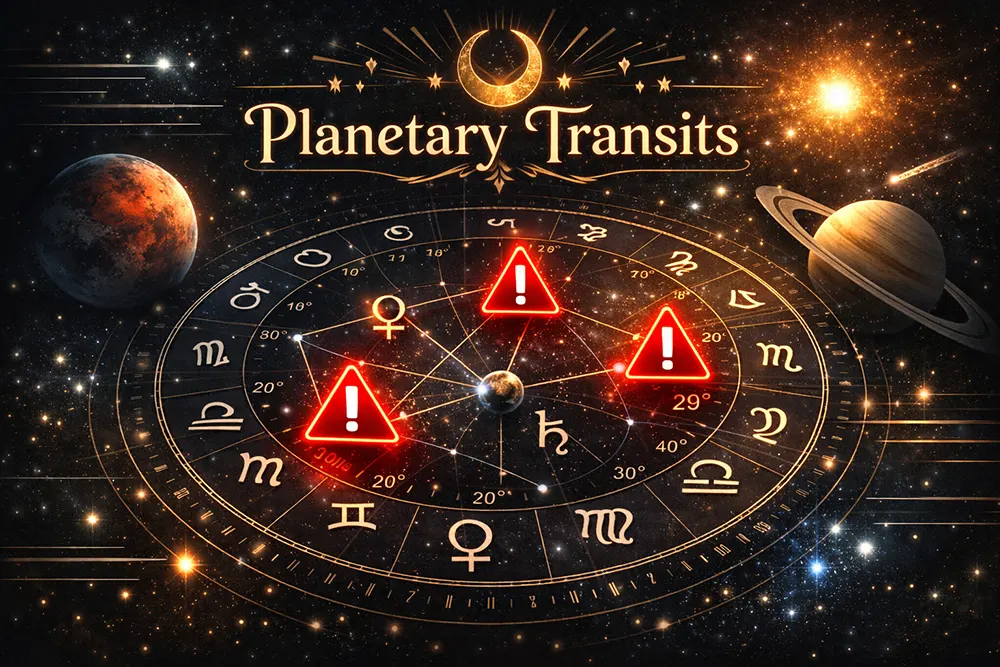
The “Cosmic Weather” metaphor is more than just a poetic device; it is a functional reality for those who track the intersection of celestial cycles and human behavior. Imagine a captain launching a vessel into the Atlantic without consulting the radar, or a lead developer pushing a major update to a live server during peak traffic without checking the logs. In the world of modern Astrology Forecasting, ignoring these signals is a choice to operate in the dark.
Defining a “Red Flag” in your chart is not about doom-mongering; it is about identifying periods of peak friction. These are the moments when the alignment of the stars creates a “bottleneck” in your personal or professional life. Whether it is a looming Saturn square or a chaotic Uranus opposition, recognizing these challenging transits early is the fundamental key to mastering your environment. By understanding the mechanics of Planetary Transits, you can move beyond fear and toward a sophisticated “Transit Protection” plan—building energy reserves and strategic buffers before the cosmic storm hits.
Understanding the Impact of Planetary Transits: The Tech Behind the Timing
To effectively utilize Astrology Forecasting, one must first understand the distinction between the “Code” and the “Environment.” In technical terms, your natal chart is your fixed source code, while Planetary Transits are the external API calls and environmental updates interacting with that code in real-time.
The “Now” vs. The “Birth”
Your birth chart is a snapshot of the sky the moment you arrived—it represents your core architecture. Transits, however, are the “Now.” They are the planets as they currently move through the zodiac, “pinging” your natal positions. When a transiting planet forms a mathematical aspect (like a square or opposition) to your natal planets, it triggers a specific event or internal shift. If the natal planet is your database, the transit is the query that forces a response.
The Frequency of Influence: Micro-Bugs vs. System Overhauls
In any strategic forecast, you must categorize threats by their “uptime” impact:
- Fast-Moving Planets (The Moon, Mercury, Venus): These move quickly across the sky. They represent the daily “noise” or minor bugs. A Mercury transit might cause a temporary communication glitch or a missed email, but it rarely redefines your life path.
- Slow-Moving Planets (Saturn, Uranus, Pluto): These are the “System Overhauls.” Because they move slowly, their influence can last months or even years. When these planets hit a red-flag position, they signal profound structural changes, career pivots, or deep psychological transformations.
Identifying which “tier” of planet is currently active in your Astrology Forecasting report is the first step in deciding whether you need a quick patch or a total system rebuild.
The Top 3 “Cosmic Red Flags” to Watch For: High-Voltage Patterns
When monitoring your Planetary Transits, not every movement carries the same weight. In strategic Astrology Forecasting, three specific configurations act as the primary “red flags” for significant life disruptions. Identifying these early allows you to allocate resources and mental energy to the areas most likely to come under fire.
The Saturn Square or Opposition: The Structural Audit
Saturn is the “Chief Auditor” of the zodiac. When it forms a square (90°) or an opposition (180°) to your Sun, Moon, or Midheaven, it initiates a stress test on your life’s foundations. If you have been cutting corners in your career, health, or relationships, this transit will expose the cracks. It feels like a sudden increase in “gravity”—tasks become harder, delays are frequent, and feelings of inadequacy may peak. This is a clear signal that your current “operating system” requires a manual update to handle a heavier load.

Mars Retrograde: The Energy Fracture
Mars represents your drive, execution, and “compute power.” When Mars goes retrograde—an event that occurs roughly every two years—the external output of energy becomes fragmented. This is a critical cosmic red flag for any strategist. Actions taken during this window often suffer from “engine stall”: projects lose momentum, legal disputes become circular, and physical burnout is common. In the context of Astrology Forecasting, a Mars retrograde warns you to halt new aggressive expansions and focus on internal maintenance.
Outer Planet Squares (Uranus and Pluto): The System Crash
While Saturn audits, Uranus and Pluto reinvent. A Uranus square brings “The Black Swan”—a sudden, jagged disruption that you didn’t see coming, often affecting your technology, finances, or personal freedom. Pluto squares, conversely, are slow-burn “System Crashes” designed to purge toxic or obsolete power structures. How these Planetary Transits impact your specific “Houses” (the 12 sectors of your life) determines where the volatility will hit—whether it’s a sudden pivot in your 10th House of Career or a deep transformation in your 4th House of Home and Security.
Astrology Forecasting: Digital Tools for Early Detection
In the era of high-frequency data, waiting for the “storm” to arrive before reacting is a failure of strategy. Modern Astrology Forecasting utilizes precision software to identify the exact window of impact, giving you a lead time that traditional methods lacked.
The Tech-Spirituality Connection: Monitoring the Logs
Just as a DevOps engineer uses monitoring tools to detect latency, you can use professional astrology software—such as TimePassages, Astro-Seek, or Solar Fire—to set “alerts” for specific degrees. By tracking Planetary Transits digitally, you remove the guesswork. You can see the exact date a heavy-hitter planet like Pluto enters the “orb” of your natal planets, allowing you to prepare your Transit Protection protocols weeks or months in advance.
Reading the “Orbs”: The Latency Phase
In astrology, the “Orb” is the degree of proximity between two planets. You don’t wait for a planet to hit 0° (exact alignment) to feel the heat. The “Applying Orb” is the latency phase—the period where the tension is building but hasn’t yet reached a breaking point. Effective Astrology Forecasting focuses on this phase. If you notice a challenging square approaching within a 3-degree orb, you are already in the “caution zone.” This is the time to back up your data, clear your schedule, and fortify your energetic boundaries.
Strategic Scheduling: The Monthly Forecast
Viewing Astrology Forecasting as a monthly “Tech Audit” ensures you are never caught off guard. By reviewing the lunar cycles, planetary ingresses, and major aspects at the start of each month, you can align your business launches or personal risks with “Green Flag” periods and go into “Safe Mode” during the Red Flags.
Transit Protection: How to Mitigate the Storm
Identifying a red flag is only half the battle; the other half is deploying an effective Transit Protection strategy. In the world of high-level Astrology Forecasting, “protection” isn’t about hiding under a rock—it’s about tactical refactoring. You wouldn’t run a heavy stress test on a live server without a backup; similarly, you shouldn’t face a hard Saturn or Pluto transit without a mitigation plan.
The “Lean In” Strategy: Tactical Compliance
The most effective way to handle a challenging Planetary Transit is to give the planet exactly what it wants before it takes it by force. If Saturn is squaring your natal Sun, it is demanding discipline and structure. Instead of resisting the “heavy” feeling, lean in: initiate a rigorous audit of your finances, tighten your daily schedule, and cut out non-essential projects. By voluntarily imposing structure, you fulfill the “Saturnian contract,” often neutralizing the more difficult external manifestations of the transit.
Energetic Boundaries: Managing the “High Voltage”
During transits involving Mars, Uranus, or Pluto, your personal “grid” is under high voltage. Transit Protection here is physiological as much as it is spiritual.
- The “Dark Mode” Protocol: During peak “Red Flag” windows, reduce your external commitments. Minimize high-stakes negotiations and social exposure to lower the risk of friction.
- System Resets: Incorporate grounding practices—meditation, physical exercise, or “tech-free” zones—to discharge the excess static electricity generated by intense Planetary Transits.
Choosing Your Battles: The Art of Cosmic Timing
A core tenet of Astrology Forecasting is knowing when to stay “offline.” If your 10th House (Career) is currently under a Martian retrograde Red Flag, it is mathematically the wrong time to launch a new brand or confront a supervisor. Transit Protection means moving these high-stakes events to a “Green Flag” window (such as a Jupiter trine), ensuring you have the cosmic wind at your back rather than in your face.
The Wisdom of the Stars: Empowerment Over Fear
Identifying “Cosmic Red Flags” in your Planetary Transits is not about living in a state of celestial anxiety; it is about reclaiming your agency. When you understand these cycles, you realize that “bad luck” is often simply “bad timing.” By integrating Astrology Forecasting into your strategic planning, you transform obstacles into controlled experiments.
A Saturnian square becomes a graduation ceremony for your discipline, and a Uranus opposition acts as a necessary software upgrade for your personal freedom. Every Red Flag is an invitation to evolve, to patch the vulnerabilities in your character, and to build a life that is “transit-proof.” The stars provide the raw data, but you provide the execution. In the modern age, preparedness is the highest form of spiritual intelligence.
Mastery Through Data: Frequently Asked Questions
Is a “Red Flag” transit always a negative experience?
Not necessarily. While they bring tension, these Planetary Transits are the primary drivers of human growth. Without the pressure of a “Red Flag” period, we rarely find the motivation to make the major life upgrades necessary for our long-term evolution.
How do I know if I’m in a “Pre-Shadow” or “Applying” phase?
Check the degrees of the moving planets. In Astrology Forecasting, the “Applying” phase begins when a planet is within 5 degrees of hitting your natal placement. This is when the “pressure” starts to build. The “Pre-Shadow” specifically refers to the degrees a planet will cover before it turns retrograde.
What is the most effective “Protection” for a Pluto transit?
Pluto transits require radical honesty and “Shadow Work.” Protection here comes from the art of letting go. The more you try to micro-manage or control a situation during a Pluto transit, the more friction you will experience. Radical release is your best defense.
Can these transits physically affect my hardware or code?
Yes, particularly those involving Mercury and Uranus. Mercury retrogrades often disrupt communication protocols and software logic, while Uranus transits can coincide with sudden hardware failures or electrical “system crashes.” Always maintain a robust backup during these specific windows.
How often should I perform an Astrology Forecast audit?
For most digital strategists, a monthly audit is ideal. This allows you to map out your high-energy “sprints” and your low-energy “maintenance” periods in alignment with the Planetary Transits of the month ahead.
Share this cosmic knowledge