
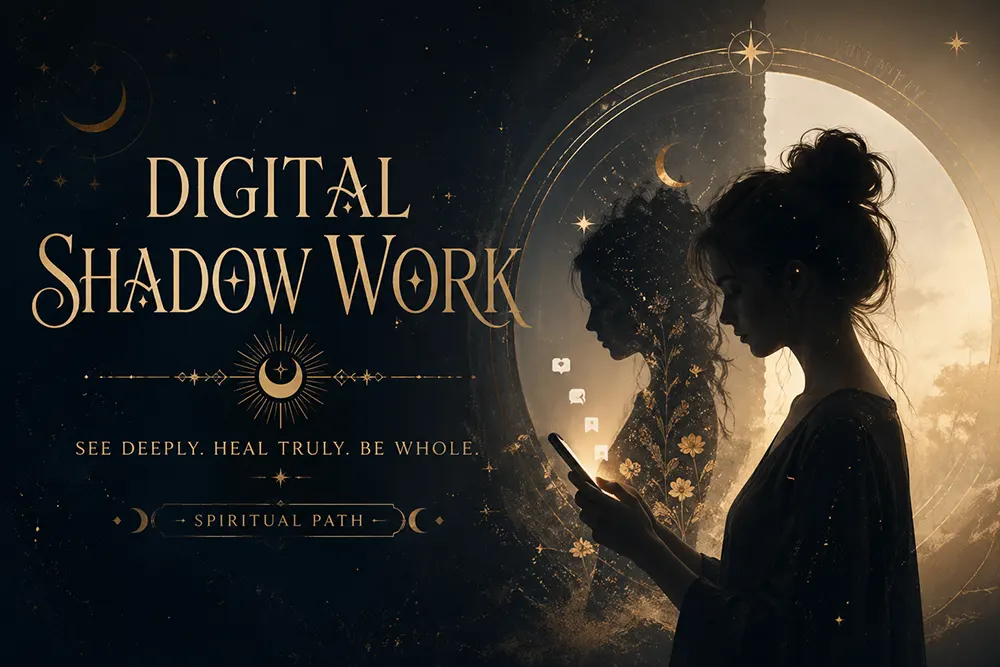
The infinite scroll has become the modern era’s campfire, yet instead of warmth, it often leaves us with a cold sense of inadequacy. We’ve all been there: staring at a screen at 2 AM, feeling a strange mix of envy and exhaustion after looking at the lives of people we barely know. This isn’t just “procrastination”—it is the manifestation of the Digital Shadow.
This concept, rooted in Jungian psychology, suggests that our online behavior is a playground for the parts of ourselves we’ve suppressed: our secret vanities, our unvented frustrations, and our deepest fears of being invisible. As defined in Encyclopedia Britannica’s analysis of Jungian analytical psychology, the shadow consists of the hidden or unconscious aspects of the soul, which in the digital age, find a perfect outlet through our social media interactions and online personas.
Social media acts as a “Black Mirror” not because of the glass, but because it reflects these unacknowledged patterns back at us with startling clarity. By engaging in Digital Shadow Work, we stop being passive victims of the algorithm and start using our digital footprints as a diagnostic tool for the soul. The goal isn’t to delete your accounts, but to find a sense of authenticity that exists both on and off the screen.
The Anatomy of an Online Persona: Why We Hide Behind the Feed
In the realm of Digital Shadow Work, the first step toward clarity is acknowledging that every profile is a performance. We don’t just “post”; we curate. This section explores how the digital world fractures our identity and where the shadow finds its footing.
The Curated Self and the Rise of the Digital Split
The version of you that exists on Instagram or LinkedIn is rarely the version of you that wakes up on a Tuesday morning. We naturally gravitate toward highlighting our “wins”—the aesthetic travel photos, the career milestones, and the filtered smiles. While this seems harmless, it creates a “Digital Split.” The more energy we invest in maintaining this perfect image, the more our messy, human, and vulnerable traits are pushed into the subconscious. This gap is exactly where the Digital Shadow grows, feeding on the parts of our lives we deem “unpostable.”
Projections: Seeing Your Shadow in the “Follow” List
One of the most revealing aspects of Digital Shadow Work is analyzing our reactions to others. Have you ever felt an intense, irrational irritation toward a creator who is “too confident” or “too successful”? Psychologically, this is rarely about them. Instead, you are likely projecting your own repressed desires or traits. If you find yourself criticizing someone for being attention-seeking, it might be because your shadow is mourning your own lack of visibility or self-expression.
The Algorithm as a Subconscious Map
While we like to think we control our feeds, the algorithm often understands our Digital Shadow better than we do. It tracks your “dwell time”—those extra seconds you spend looking at something that makes you angry or jealous. By identifying your unconscious patterns, you can see that your feed isn’t just showing you what you like; it’s showing you what you are obsessed with, whether that obsession is fueled by love or by a hidden insecurity.
Expert Tip: Your “Muted” list is a goldmine for Digital Shadow Work. Often, the people we mute aren’t “annoying”—they are simply reflecting a truth about our current insecurities that we aren’t ready to face.

Identifying Your Unconscious Patterns: Decoding Your Digital DNA
The algorithm does not simply guess your preferences; it reflects who you are in your most private moments. To master Digital Shadow Work, you must transition from mindless scrolling to active observation. Your digital habits are not random accidents—they are repetitive blueprints of your internal world.
The Social Comparison Trigger and the Worthiness Gap
The “Social Comparison Trigger” is that instantaneous drop in your mood the moment you glimpse someone else’s highlight reel. While it feels like a reaction to their life, it is actually a revelation of your perceived lack. According to Psychology Today’s research on social comparison theory, the habit of measuring our behind-the-scenes reality against everyone else’s public highlight reel fuels the Digital Shadow, leading to chronic dissatisfaction. Instead of closing the app in frustration, ask yourself: “What specific trait in this post do I feel is missing in my own life?”
The Rage-Like and the Anatomy of Doomscrolling
Have you ever caught yourself “hate-reading” comment sections or pausing on a post just to fuel your indignation? This is the “Rage-Like” or “Doomscrolling” phenomenon. Within the framework of identifying your unconscious patterns, these moments are highly diagnostic. They signal that your shadow is seeking external validation for an internal conflict. If you are triggered by someone’s “unearned” success, your shadow may be grappling with your own fears of inadequacy or stagnant manifestation efforts.
Ghosting, Muting, and the Fear of Authenticity
Your avoidance patterns are just as revealing as your engagement habits. “Ghosting” a conversation or “Muting” a friend who is currently thriving often points to a shadow that is too fragile to handle direct interaction or honest reflection. When we hide from others online, we are usually hiding from a part of our own cosmic blueprint that we have yet to accept. Identifying these behaviors is the first step toward reclaiming your authenticity.
Expert Tip: Set a “Trigger Timer.” If you spend more than 60 seconds focused on content that makes you feel inferior, stop and record the exact emotion in a journal. This is the fastest way to bring the shadow into the light.
Healing the Digital Split: Bridging the Gap to Authenticity
Healing the Digital Shadow is not about achieving “perfection” or curating a flawless aesthetic. It is about “Integration”—the psychological process of bringing your true, unfiltered self into the digital space so that the “Digital Split” no longer causes psychic friction.
Beyond the Filter: The Courage to be Uncurated
To heal, we must challenge the dominance of the “Curated Self.” This involves a process of spiritual awakening where you realize that your inherent value is not a metric to be measured by others. Practicing authenticity online can be as simple as sharing a genuine struggle alongside a success or posting a photo that hasn’t been edited to satisfy an algorithm. According to experts at Mindful on building a healthy relationship with technology, when you stop hiding the “messy” parts of your life, the Digital Shadow loses its power, and your digital interactions become a source of energy rather than a drain.
Integrating Radical Authenticity
Authenticity is often mistaken for “oversharing,” but in the context of Digital Shadow Work, it specifically means “Alignment.” It is the intentional practice of ensuring your digital output matches your internal frequency. When you post from a place of truth rather than a desperate need for validation, you shift the energetic quality of your interactions. You move from a “Scarcity Mindset” (craving likes) to an “Abundance Mindset” (sharing value). This shift is essential for those exploring manifestation or seeking to align their online presence with their true purpose.
Conscious Consumption and Intentional Scrolling
The final stage of healing the digital split is shifting your intentions. Before opening an app, ask yourself: “Am I looking for genuine connection, or am I seeking a distraction from my current feelings?” By setting a conscious intention, you disrupt the unconscious loop that feeds the shadow. You can even use tools like phone number numerology to understand how your digital identity’s vibration affects your social energy and overall cosmic guidance.
Case Study: Recent digital wellness data suggests that users who practice “Intentional Posting”—sharing content based on personal values rather than trending topics—report a 40% decrease in social anxiety and a significant increase in overall life satisfaction.
Digital Shadow Work Exercises: Practical Steps to Reclaim Your Power
Knowledge without action is merely a distraction. To truly transform your relationship with technology, you must move beyond theory and engage in active Digital Shadow Work. These three exercises are designed to help you peel back the layers of your online persona and confront the identifying your unconscious patterns process head-on.
1. The “Trigger Audit” Journaling Session
Grab a physical notebook—avoiding digital screens for this part is crucial. List the last three accounts or posts that made you feel a “clench” in your chest or a flash of irritation.
- The Mirror Question: “What does this person have that I am currently denying myself permission to have?”
- The Shadow Link: If you hate their “vanity,” are you suppressing your own need to be seen? If you hate their “laziness,” are you pushing yourself toward burnout?
2. Unfollow for Wholeness: The Energetic Cleanse
Your “Following” list is a curated environment that feeds your subconscious 24/7. An essential part of Digital Shadow Work is pruning this garden.
- The Rule: If an account makes you feel “less than” rather than “inspired by,” it is an energetic drain.
- The Action: Unfollow or mute. This isn’t about being “weak”; it’s about protecting your cosmic guidance and ensuring your digital space supports your manifestation goals.
3. The Digital Fast: Meeting the Silent Self
Schedule a 24-hour “Digital Fast.” When you remove the constant stream of external “noise,” your Digital Shadow has nowhere to hide. You will likely feel a surge of anxiety or boredom—this is the “withdrawal” of the persona. Use this time to reconnect with your Big Three astrology traits. Ask yourself: “Who am I when no one is watching, liking, or commenting?”
Expert Tip: Try “Batch-Checking” instead of “Real-Time Scrolling.” By checking social media only twice a day, you break the dopamine loop that keeps your shadow in a state of constant, reactive hunger.
Radical Wholeness in a Digital Age
We live in a world that profit-maximizes our insecurities, but Digital Shadow Work offers a path to reclamation. Identifying your unconscious patterns is not about shaming yourself for having an ego or wanting to look good in a photo. It is about authenticity—the radical act of being a whole human being in a landscape of 2D fragments.
The Authentic Journey Ahead
As you continue this practice, you’ll notice a shift. The “need” for likes will transform into a “desire” for genuine connection. The anger you felt toward influencers will soften into an understanding of your own unmet needs. You don’t need to delete social media to find peace; you simply need to bring the light of your consciousness into the digital dark.
By integrating your Digital Shadow, you move from being a user of technology to being a master of your own digital experience. You become someone who uses the scroll not to escape life, but to understand it more deeply.
Call to Action: What is the one “unconscious habit” on social media that drains you the most? Is it the comparison trap, or the late-night doomscrolling? Share your experience in the comments below—let’s bring these shadows into the light and start the journey of Digital Shadow Work together!
FAQs: Mastering Your Digital Shadow
How do I start Digital Shadow Work if I feel overwhelmed?
Start small. Pick just one “triggering” account today and ask yourself why it bothers you. Awareness is 90% of the work.
Is it bad to have an online persona?
Not at all. We all have “Personas” (the social masks we wear). The goal is to ensure your persona is a bridge to your true self, not a wall that hides it.
Does the algorithm actually change when I do this work?
Yes. Algorithms are designed to give you more of what you engage with. When you stop “rage-clicking” and start seeking content aligned with your spiritual awakening, your feed will literally transform over time.
Can I do shadow work for my professional LinkedIn profile?
Absolutely. Professional shadow work often involves looking at your “Imposter Syndrome” or your need to appear hyper-competent at the expense of your health.
How long does it take to see results?
You will likely feel a sense of “relief” immediately after your first Trigger Audit. However, deeper integration of your authenticity is a lifelong journey.
Share this cosmic knowledge